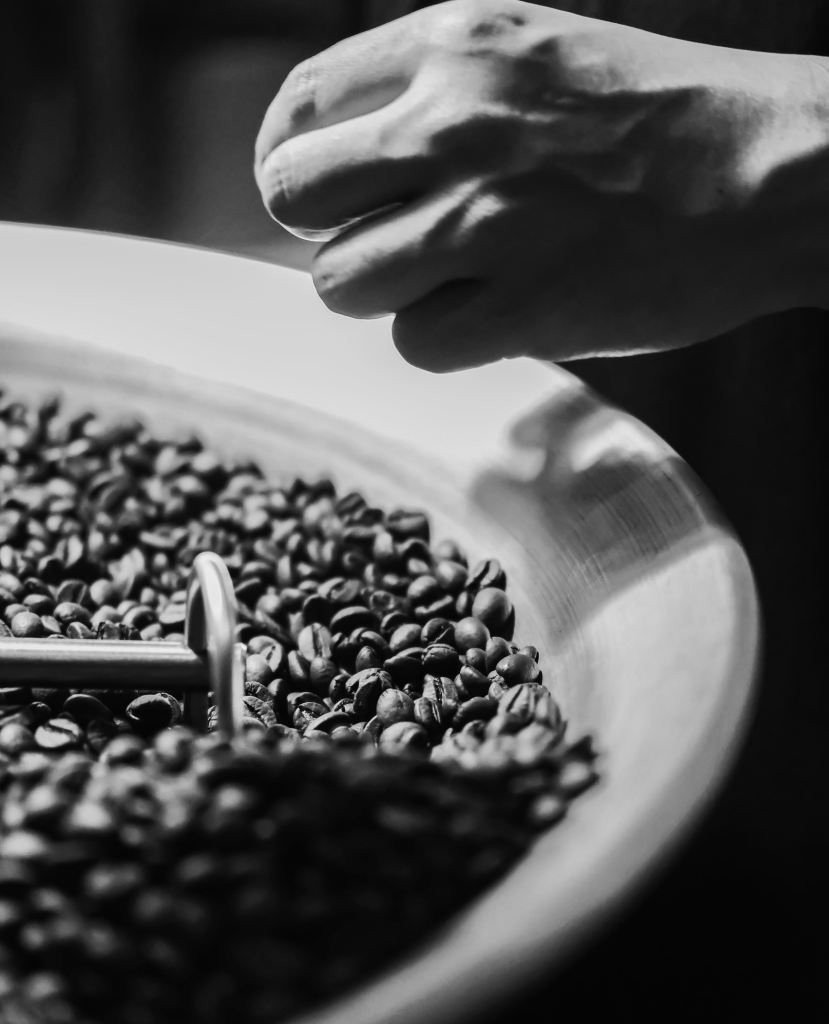
In Japan, craftsmanship—or the spirit of “shokunin“—goes far beyond technical skill.
It’s a way of life.
For many artisan roasters, coffee roasting is not just a job, but a personal quest.
“Roasting in sleep and wakefulness — always in pursuit of the perfect cup.”
This means never switching off their senses, always thinking about how to bring out the best in each bean. It’s not just about roasting coffee—it’s about chasing an ideal that may never be fully reached, but is always worth striving for.
Japanese roasters are known for their uncompromising attention to detail. Each roast is carefully calibrated, often by hand, to match the bean’s origin, density, and moisture. Automation takes a back seat to sensory judgment—watching the color, listening to the first crack, and adjusting heat with split-second timing.
For them, every roast is a new experiment. A new opportunity to get closer to that “still unseen, ideal cup.” This deep respect for the process and the material creates coffee that is more than just a beverage—it’s an expression of quiet excellence, balance, and depth.
This dedication is deeply rooted in Japanese culture—where beauty lies in subtlety, mastery is earned through repetition, and the smallest acts are done with great care.
The mindset of Japanese roasters echoes the principles of tea ceremony (sado), where every movement is deliberate, and no step is wasted. Just as tea masters perfect the art of a single pour, roasters in Japan refine the timing, airflow, and even the sound of the beans to achieve harmony.
Their philosophy is also shaped by monozukuri—the Japanese tradition of making things with precision and heart. In this context, roasting coffee becomes not just a process, but an act of quiet devotion to perfection.
When you taste coffee from a Japanese roaster, you’re not just drinking coffee.
You’re tasting a lifetime of dedication—and a culture that finds meaning in mastery.